
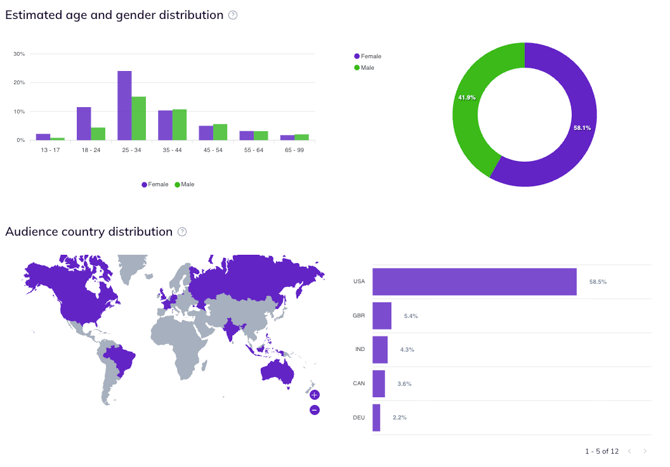
The audience demographic data available in Winnin Intelligence platform is estimated by Winnin's proprietary technology, using only public, anonymized, and aggregated engagement data. Currently, such data is composed by YouTube and Instagram videos public data, meaning that all audience numbers for topics, subtopics, creators, and tags are derived exclusively from data related only to these platforms. The higher the share of videos within a given territory, the closer the estimated audience will be to the real one.
In line with data privacy and protection best practices, the profile images are analyzed solely to infer age ranges and gender at an aggregate level, and never to identify specific people. When the sample size is sufficiently large, this approach allows us to build a representative demographic profile of the audience.
That said, it is not possible to estimate audiences for kids’ channels or for channels that disable comments, since no public user data can be collected in those cases.
Breakdown by country
The calculation for country-level breakdowns happens in three steps:
1. We identify who commented on the content
For each piece of content linked to the topic, we look at the people who interacted with it. Each person is counted uniquely — meaning that even if someone engages with multiple pieces of content from the same topic, they count as one person.
2. We identify where they are from
For each of these people, we identify their country of origin based on public profile information. Anyone without a country listed is excluded from the calculation to avoid skewing the results.
3. We group by country
We add up how many unique people from each country showed interest in the topic. This allows us to show, for example: "on this subject, this many people from Brazil, this many from the United States, this many from Portugal," and from there calculate each country's proportion.
Two important points: — We only consider interest from the last 12 months, to reflect the audience's current behavior, not outdated data. — Each person is counted only once per topic, ensuring the number represents real people and not duplicates. In summary: the audience by country shows how many distinct people from each location showed interest in that subject over the past year — an estimate of where, geographically, the interest in each topic lies.